

Overview
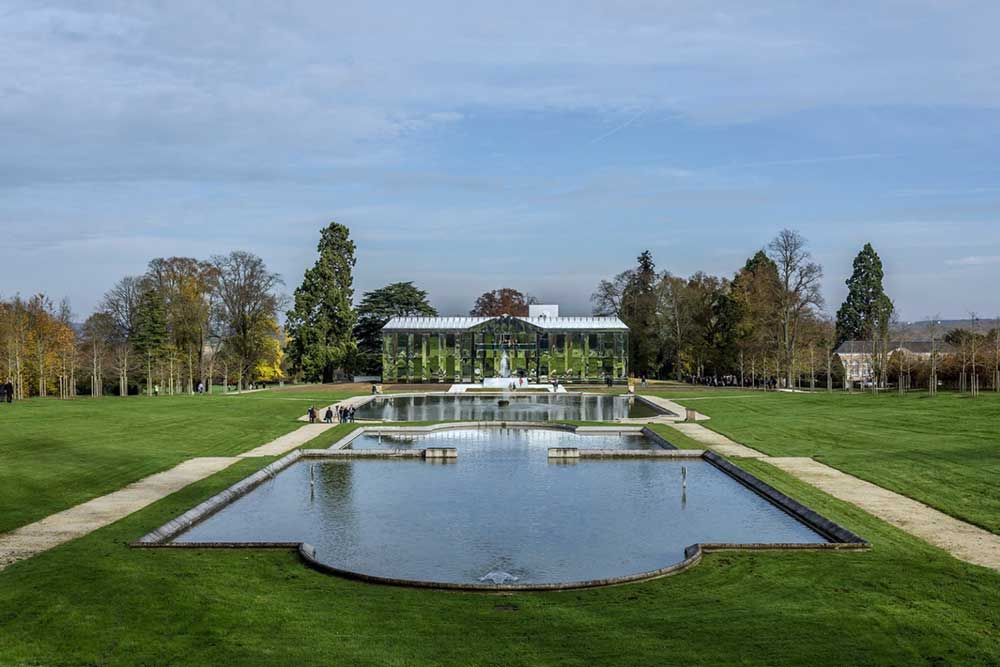
The scenery composed of the castle-like architecture and the pond is quite reminiscent of Mr. Darcy’s Pemberley – Chatsworth House, the filming location of Jane Austin’s novel Pride & Prejudice, despite its modern and contemporary look. To amaze us, this beautiful site is not even in UK, but in France. This week we will introduce FRAC Ile-de-France Arts Centre and the stainless steel application in it.
FRAC Ile-de-France Arts Centre in Bussy-Saint-Martin
FRAC Ile-de-France Arts Centre, one of the 3 exhibition spaces of the FRAC, is located in the heart of the 54-hectare Parc culturel de Rentilly-Michel Chartier in Bussy-Saint-Martin, west of Paris. It is a renovation project completed in 2014, complementing the Paris space as both a contemporary art gallery (Eckersley O’Callaghan 2025) and an intercommunal museum (Seine-et-Marne Attractiveness 2025).
To avoid confusion associated with FRAC Ile-de-France Arts Centre and to highlight the topic of this article, the address Bussy-Saint-Martin has to be added. In this way, it differentiates itself from FRAC’s another two main exhibition spaces of Le Plateau and Les Réserves as below listed (Platform 2025),
- Le Plateau, Paris: a place for experimentation, production and support for contemporary creation.
- Les Réserves, Romainville: a site for storing the collection and making it accessible to a wider audience.
FRAC Ile-de-France Arts Centre in Bussy-Saint-Martin hosts two 500-squre-meter exhibition halls, covering an area of 1350 square meters in total. Looking outside, it is a work of modern art on its own. With its mirror finished stainless steel façade, the Arts Center merges itself seamlessly with its unique natural setting between English-style garden, French perspective and forests. It is hard not to recall the movie scene from Pride & Prejudice at the sight of it.
The Project Background of FRAC Ile-de-France Arts Centre
Any background information of FRAC Ile-de-France Arts Centre will be incomplete without the introduction of the FRAC.
What is FRAC?
FRAC is abbreviated from its French Name Fonds régionaux d’art contemporain. In English, FRAC stands for the Regional Contemporary Art Funds. Born in 1982 as a joint effort between the State and the Regions, FRAC is a public organization financed by the Ile-de-France Region, the State and the City of Paris.
FRAC aims to collect, disseminate and transmit contemporary art by building bridges between artists and citizens, with a mission to “build a collection of contemporary art in each region, make it accessible to as many people as possible, and support artists at all stages of their journey” (Île-de-France Frac 2025). For their expertise, “Frac” has been awarded as a label by law since 2016.
The History of FRAC Ile-de-France Arts Centre
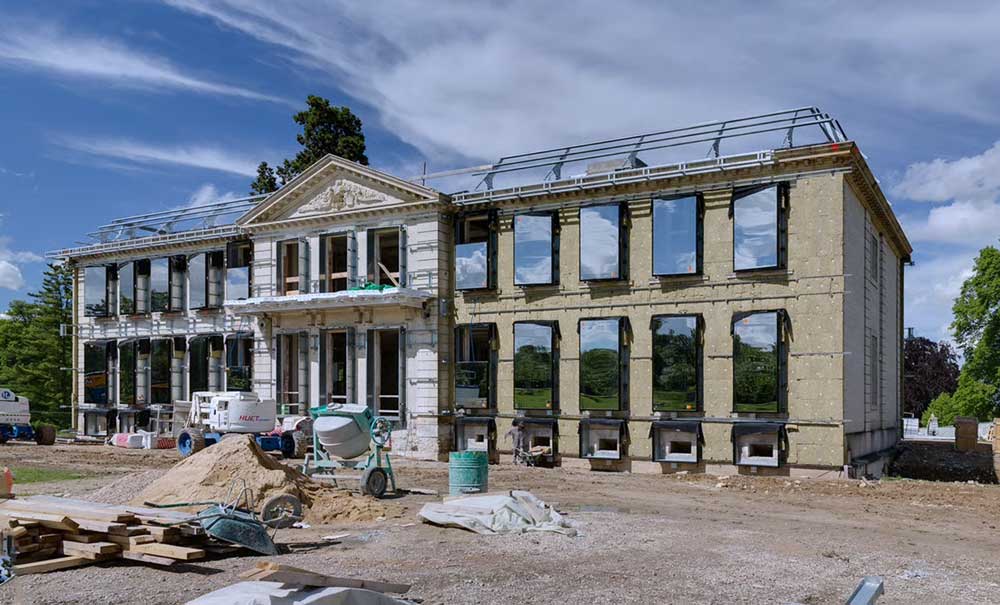
FRAC Ile-de-France Arts Centre is not a brand-new project built from zero but transformed from a dilapidated castle built in the 16th century. That’s how it brings out the Château de Rentilly, its predecessor to briefly narrate its history.
The first castle built on the land of Rentilly could trace back to the early 16th century, but it got destroyed and rebuilt in 1780 with a new appearance of an Italian castle. The owners rotated until Isaac Thuret acquired the estate in 1819 when the estate with its interior completely redesigned under the wealthy Thuret family, embraced an important boom and development.
In 1846, the owner changed to André family who turned it into a sumptuous estate. The development continued in 1865 with the construction of the mirror basins of the French perspective. In 1890, the André family sold the estate to the Menier family of chocolatiers, who had Turkish baths and the trophy room set up in 1891 and three pavilions built during 1896 to 1910. However, the castle got burned on 21 August 1944 due to World War II.
Between 1953 and 1954, the castle was rebuilt on the basis of the old one, losing its former glories. It became less imposing and less lavish than before, but the Menier family held it long from generation to generation for almost a century since 1890 to 1988.
In 1987, the estate was bought by the Public Development Institution of the new city of Marne-la-Vallée. From 2001, the Community of communes (then agglomeration) of Marne and Gondoire bought part of the estate and launched a vast rehabilitation project.
The Rehabilitation for FRAC Ile-de-France Arts Centre: From 2011 to 2014
In 2011, a call for applications was launched for the rehabilitation of the site by Communauté d’agglomération de Marne et Gondoire in partnership with FRAC. Four teams were shortlisted in the competition, each with an artist and an architect. The team formed by the multidisciplinary artist Xavier Veilhan, the architectural office Bona-Lemercier, and Veilhan's frequent collaborator as well as stage designer Alexis Bertrand won the competition. They were entrusted the rehabilitation from 2011 to 2014 (Seine-et-Marne Attractiveness 2025).
The Design of FRAC Ile-de-France Arts Centre
As the castle held no significant historic value, the team were free to play with the structure to embrace the challenge “to create both an exhibition facility and an art piece on the scale of a building” proposed by FRAC (Anna Yudina 2022).
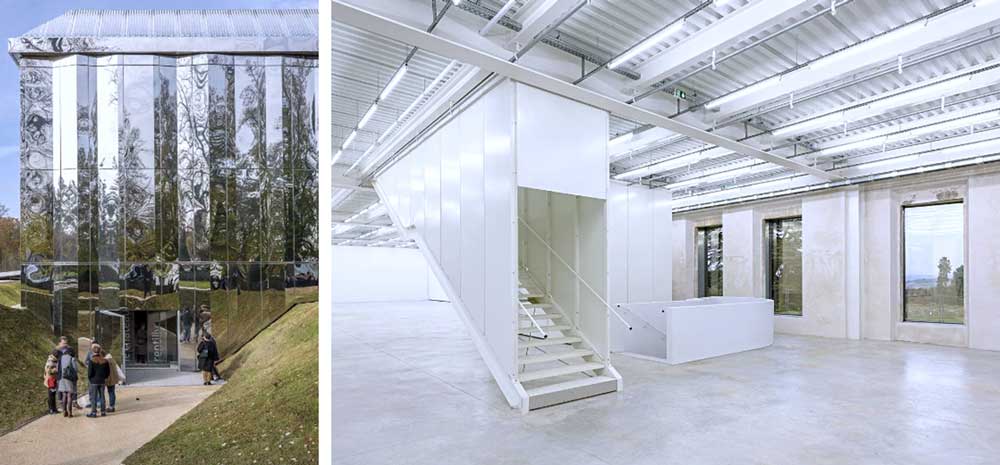
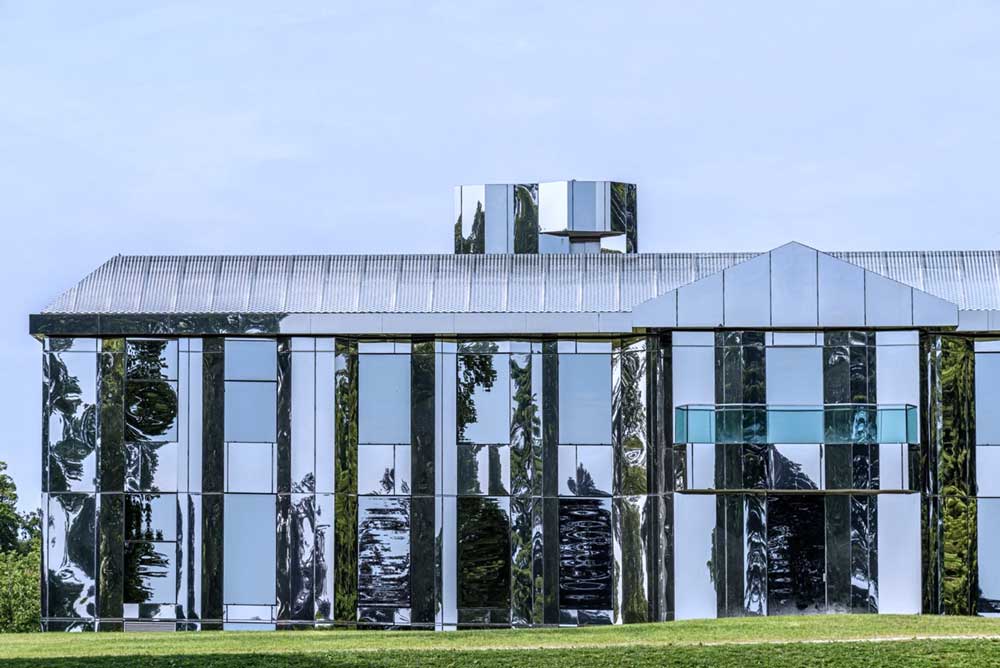
The initial idea was to cover the whole castle with a camouflage pattern, but later the team came up with a better solution of blending the château with the landscape while highlighting its strong geometries through mirror facade. They decide to apply mirror-polished stainless steel to envelop the structure. To reflect views of the beautiful natural scenery, they also chose reflective windows to match the stainless steel surface.
The interior was also redesigned like stripping out all the walls, adding steel frames and creating new piled foundations to maximize the internal exhibition space, except the basement which remained intact to serve as the new public entrance and the museum lobby.
Stainless Steel Applied in FRAC Ile-de-France Arts Centre
Roughly 27 tons of 304L stainless steel sheets in mirror finish were supplied for the FRAC Ile-de-France Arts Centre (ISSF 2025). To achieve the perfect mirror finish envisioned by Xavier Veilhan, figuring out the right sheet thickness was the key. To work with the architect, the team did research on different materials and suppliers, conducted tests and developed prototypes. 1.5mm thickness proved to be the right one to eliminate distortions and imperfections for optimal performance (Eckersley O’Callaghan 2025).
Stainless Steel from CIVMATS China
If you are looking for mirror polished stainless steel sheet plate coils as in the case of FRAC Ile-de-France Arts Centre from China, CIVMATS can be your most reliable choice. Apart form mirror polished, CIVMATS can also process varied finishes like BA, No.4, HL per your specific demand.
CIVMATS proudly manufacture and export worldwide quality stainless steel materials. Long products like stainless steel tube pipe, bar, wire & ropes are customizable for your multiple options. Choose CIVMATS, choose safety and reliability in China.